
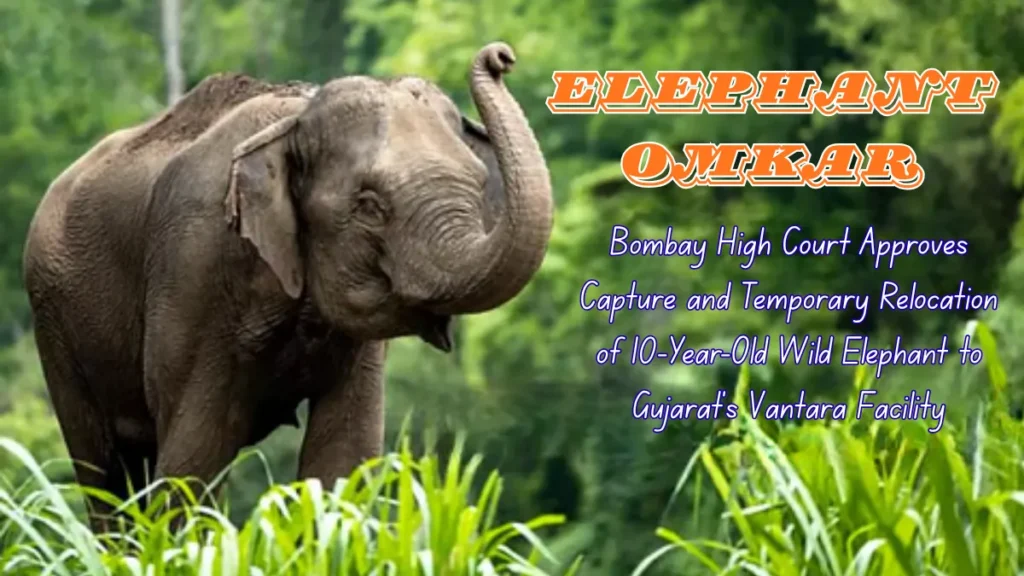
KOLHAPUR, INDIA — In a significant development highlighting India’s escalating human–elephant conflict, the Bombay High Court’s Kolhapur bench has permitted the capture and temporary rehabilitation of a young wild elephant named Omkar. The court has directed that the animal be shifted to the Vantara facility in Gujarat, where its welfare and training will be monitored until a high-powered expert committee finalizes long-term recommendations.
The Elephant Omkar story has drawn national attention—not only because it involves a displaced subadult elephant wandering across state borders, but also because the case raises sharper questions about habitat loss, ecological pressures, wildlife safety, and the conflict between conservation goals and human settlements.
A Young Elephant Caught Between Forests and Farmlands
Omkar, a 10-year-old male elephant, first came into the spotlight earlier this year when he was spotted roaming in North Goa. The elephant, originally part of a six-member herd in Maharashtra’s Sindhudurg region, was separated from his group and began moving across forest patches, agricultural lands, and residential areas.
As per earlier wildlife tracking reports, Omkar frequently entered paddy fields and foraged for coconuts, bananas, and arecanuts—behavior common among young elephants left without experienced herd leaders. This growing pattern of crop raiding heightened tensions in local communities and raised immediate concerns for public safety.
The Elephant Omkar story quickly evolved from routine wildlife monitoring to a high-alert situation after authorities noted the elephant’s unpredictable movements and his increasing interaction with human settlements.
State Government Flags Safety Risks
During court proceedings, Maharashtra’s state government emphasized the urgency of relocating Omkar. Officials argued that the elephant had begun posing a serious threat to human life and property, especially after an incident earlier this year in Dodamarg (Sindhudurg), where Omkar was linked to the death of a local resident.
According to the Forest Department, Omkar’s behavior had shifted from anxious and distressed to aggressive and erratic—traits often witnessed in young elephants who lose their guiding herd or elder bull mentors. This, officials argued, heightened the risk of further human casualties and increased Omkar’s own vulnerability.
The government recommended Vantara, a large wildlife care facility operated by the Radhe Krishna Temple Elephant Welfare Trust (RKTWET) in Jamnagar, Gujarat, as the only center currently equipped and willing to shelter, train, and rehabilitate the displaced animal.
Petitioners Oppose Rehabilitation to Gujarat
The High Court was approached by petitioner Rohit Prakash Kamble, a lecturer at Dr. Babasaheb Ambedkar Technological University, who challenged the state government’s decision to transfer the elephant out of Maharashtra.
The petitioner argued that:
- Omkar was born and raised in the forests of the Western Ghats, an ecologically rich but fragile zone stretching across Maharashtra and Karnataka.
- His migration to Maharashtra was natural, shaped by terrain and seasonal movement.
- Transferring him to Gujarat—where the climate is hotter and drier, and where native wild elephants are absent—would be unsuitable and potentially harmful to his wellbeing.
- Keeping a wild elephant in captivity at a facility like Vantara could permanently alter his natural instincts and inhibit any future chance of returning to the wild.
- The decision undermines ecological principles and disregards constitutional protections for wildlife.
The intervenors supporting the petition stressed that elephants often wander into settlements not because they are dangerous, but due to habitat loss, deforestation, encroachment, mining activities, shrinking green corridors, and human expansion into traditional elephant routes.
They claimed the rehabilitation plan violated wildlife welfare norms and called the relocation “illegal and unconstitutional.”
Forest Department Defends Its Stand
Represented by Advocate T. J. Kapre, the Forest Department maintained that relocation was necessary for both public security and Omkar’s health.
Kapre argued:
- Vantara was the only facility with the infrastructure, willingness, and expertise to take Omkar in.
- The elephant’s current movements were chaotic and dangerous, triggered by the absence of older male elephants who typically guide younger bulls.
- Allowing him to remain in densely populated regions created risks not only of damage to property and agriculture but also of potential retaliation from affected communities.
- Without trained intervention, the elephant could become unmanageable, further endangering villagers and himself.
This position became a key part of the state’s defence in the Elephant Omkar story.
High Court on Elephants: Keystone Species Under Threat
In its detailed order, the High Court underscored the ecological importance of elephants, describing them as “keystone species” whose presence and activities directly shape and sustain the ecosystems they inhabit.
The bench, comprising Justices Makarand S. Karnik and Ajit B. Kadethankar, noted:
- Elephants significantly influence forest regeneration, seed dispersal, water distribution, and vegetation patterns.
- India’s elephant population, despite conservation efforts, remains listed as endangered.
- Habitat loss and fragmentation are pushing elephants—particularly young subadults—into farmlands and villages.
The bench further observed that “human–elephant conflict is now a major conservation and livelihood challenge,” driven largely by expanding agricultural land use, infrastructure development, and shrinking natural corridors.
The court highlighted how such conflicts carry both ecological and socio-economic consequences:
- Small farmers suffer severe losses from crop destruction.
- Displaced or harmed wildlife reduces biodiversity and disrupts forest connectivity.
- Endangered species, already under pressure, face further threats from human retaliation or accidental injury.
Court Permits Capture with Strict Welfare Safeguards
After reviewing submissions from all sides, the High Court issued the following key directives:
1. Capture Allowed with Safety Precautions
The state is permitted to capture Omkar, but must ensure the operation is handled with:
- minimum physical harm,
- minimal psychological trauma, and
- monitoring by trained forest and veterinary teams.
2. Temporary Translocation to Vantara
The bench ruled that Omkar may be moved temporarily to Vantara in Gujarat, where his welfare, behaviour, and training will be monitored.
3. Oversight by High-Powered Committee
The court has appointed a high-powered committee to:
- Review Omkar’s health, behaviour, and adaptability.
- Assess whether he can eventually be released back into the wild.
- Recommend long-term relocation, either to a forest region or continued monitored care.
4. State to Submit Detailed Proposal
The government must submit a complete proposal outlining:
- The method of capture
- Temporary translocation procedures
- Long-term rehabilitation or release plans
The committee is expected to provide recommendations within two weeks of receiving the proposal.
Further hearings have been scheduled for November 24.
What Omkar Represents: A Larger Crisis in India’s Wildlife Spaces
The Elephant Omkar story is far more than an isolated case of a wandering elephant; it reflects a deepening environmental and social crisis unfolding across India.
Escalating Human–Elephant Conflicts
India records thousands of incidents every year involving elephants entering farms and villages. These confrontations often result in:
- Damage to standing crops
- Loss of property
- Injuries and fatalities on both sides
- Retaliatory attacks on elephants
- Displacement or death of young elephants
As seen in Omkar’s case, these conflicts create difficult choices for wildlife managers.
Shrinking Elephant Habitats
Rapid urbanization and agricultural expansion are reducing elephant corridors in the Western Ghats, leading to:
- Fragmented forests
- Broken migratory paths
- Isolation of elephant herds
- Increase in stray or solitary bulls
Omkar’s separation from his original herd exemplifies this broader challenge.
Climate and Habitat Suitability Debates
The debate over whether Vantara is a suitable environment for Omkar highlights another emerging issue:
Should displaced wild elephants be relocated to distant facilities, or should states focus on restoring natural habitats?
This question, now central to the Elephant Omkar story, is likely to influence wildlife policies in the coming years.
A Turning Point for Conservation Policy
The High Court’s order balances complex priorities:
- Protection of human life
- Welfare of endangered wildlife
- Long-term ecological sustainability
- Expert-led decision making
In directing a high-powered committee to study Omkar’s future, the court has ensured that any final decision will be rooted in scientific justice rather than administrative urgency.
The Elephant Omkar story has become a crucial case study for how India handles wildlife displacement, habitat fragmentation, and rising conflict between humans and megafauna.
Also read: Vantara Zoo Jamnagar: India’s Largest Animal Rescue and Conservation Project
What Happens Next?
Over the coming weeks:
- The state will capture Omkar under strict guidelines.
- He will be transported to Vantara for temporary care.
- Specialists will monitor his health, stress levels, training responses, and adaptability.
- The committee will evaluate whether Omkar should be:
- Re-released into a suitable forest zone,
- Shifted to another sanctuary, or
- Kept under managed care for long-term safety.
The final decision will likely shape future protocols for handling solitary or distressed wild elephants across India.
Also read: Can Normal People Visit Vantara? Inside the World’s Largest Wildlife Rescue Center
Conclusion: A Young Elephant at the Centre of a National Conversation
The Elephant Omkar story is emblematic of an unfolding ecological reality: as India’s natural forests shrink and human settlements expand, wildlife is increasingly caught in the crossfire.
Omkar’s journey—from the forests of the Western Ghats to the farmlands of Maharashtra, and now to a rehabilitation center in Gujarat—highlights the urgent need for:
- Stronger habitat protection
- Restored migration corridors
- Sustainable development strategies
- Scientific wildlife management
- Community involvement in conservation
Whether Omkar eventually returns to the wild or remains under structured care, his case has already sparked a national conversation on balancing human development with the rights and survival of India’s wildlife.
The next chapter of the Elephant Omkar story will unfold when the high-powered committee submits its recommendations later this month.