

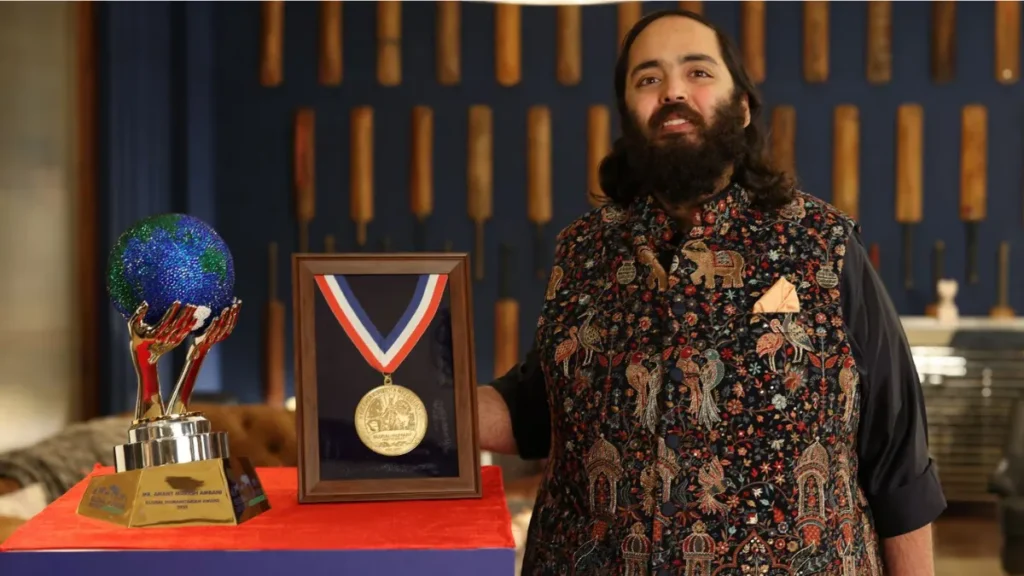
In a landmark moment for India’s conservation movement, Anant Ambani receives the Global Humanitarian Award, becoming the youngest recipient and the first Asian ever to be honoured by the prestigious Global Humane Society. The award, conferred during an event attended by the world’s leading wildlife experts, conservation researchers, and institutional heads, acknowledges not only his personal dedication to animal welfare but also the transformative impact of Vantara, the pioneering wildlife rescue and rehabilitation initiative he leads.
The recognition marks a turning point in global conservation narratives, placing India and its homegrown models of ecological stewardship at the forefront of international discussions. Vantara, founded under Anant Ambani’s leadership, has rapidly emerged as one of the world’s most sophisticated and ethically driven conservation programmes, integrating modern veterinary science, scientific habitat restoration, and long-term species recovery.
A Historic Milestone: Youngest and First Asian Honoured
When Anant Ambani receives the Global Humanitarian Award, it does more than celebrate individual achievement; it underscores a new generational approach to conservation-one that merges empathy, scientific precision, and a deep cultural respect for all life forms.
The Global Humane Society honoured him for demonstrating unprecedented commitment to animal welfare, large-scale rescue operations, and a scientifically grounded approach to species protection. The accolade is typically reserved for leaders who have shown lifelong dedication to animal welfare, making Anant Ambani’s achievement a rare and extraordinary milestone.
Held in Washington, DC, the ceremony drew conservationists, zoologists, policy leaders, and wildlife researchers from across the world. The gathering highlighted how Vantara’s model-unique in its scale, infrastructure, and scientific ecosystem-is influencing global thinking on wildlife protection and rehabilitation.
Anant Ambani’s Vision: A Philosophy Rooted in Compassion and Duty
In his acceptance speech, delivered to a standing ovation, Anant Ambani reflected on the timeless Indian principle of sarva bhuta hita—the well-being of all living beings. He emphasised that conservation must not be seen as an obligation for future generations but as a collective responsibility that demands immediate action.
“I thank the Global Humane Society for this honour. For me, it reaffirms a timeless principle-the well-being of all beings. Animals teach us balance, humility, and trust. Through Vantara, our purpose is to give every life dignity, care, and hope, guided by the spirit of seva. Conservation is not for tomorrow; it is a shared duty we must uphold today,” he said.
His message resonated deeply with conservationists worldwide, who have often argued that sustainable wildlife preservation requires more than infrastructure-it requires compassion, consistency, and a commitment to coexistence.

International Praise for a New Conservation Benchmark
Dr. Robin Ganzert, President and CEO of the Global Humane Society, underscored the exceptional nature of Vantara’s work. Her remarks positioned the initiative as a groundbreaking model for the future of global wildlife care.
“Vantara receiving the Global Humane Certified distinction reflected not only excellence in care, but a profound dedication to giving every animal dignity, healing, and hope. And there is no greater champion of that vision than Anant Ambani. The ambition, scale, and heart behind Vantara have set a new benchmark for what modern animal welfare can look like,” she said.
Her endorsement reinforced how Vantara’s scientific rigor and ethical foundations are reshaping global standards, inspiring other conservation programmes to consider similar multidisciplinary approaches.

A Rigorous Certification Process That Sets Vantara Apart
The American Humane Society’s certification is known globally for its uncompromising evaluation criteria. Only institutions that demonstrate the highest standards of ethical, scientific, and sustainable care earn this recognition. Vantara underwent a wide-ranging audit, covering:
- Animal nutrition and species-appropriate diets
- Behavioural enrichment programmes for mental well-being
- Environmental quality and habitat design
- Veterinary procedures and long-term medical care
- Expertise and training of caregivers and professionals
- Detailed species-specific welfare protocols
- Safety, emergency response systems, and ethical management
The successful certification was widely celebrated in the conservation community, as it affirmed that Vantara not only meets but exceeds many global benchmarks.
A New Conservation Ecosystem: Beyond Rescue and Rehabilitation
What makes Vantara truly unique is its integrated ecosystem-combining immediate rescue operations with long-term scientific conservation strategies. Unlike traditional wildlife facilities that primarily function as shelters, Vantara operates as a comprehensive conservation continuum. Its programmes span:
1. Large-Scale Wildlife Rescue and Medical Treatment
Vantara rescues injured, abandoned, or mistreated animals, providing world-class medical care through specialised treatment units and advanced diagnostic systems.
2. Long-Term Rehabilitation and Specialised Habitats
The initiative has developed expansive, scientifically designed habitats tailored to the behavioural and physiological needs of multiple species, ensuring a dignified and enriched life for rescued animals.
3. Species Recovery and Genetic Research
A significant part of Vantara’s mission involves restoring endangered species populations through controlled breeding, genetic mapping, and scientific rewilding techniques.
4. In Situ and Ex Situ Conservation Collaboration
Vantara partners with global institutions, research bodies, and conservation experts to protect fragmented wildlife populations and support ecosystem restoration.
5. Reintroduction Pathways for Endangered Species
The long-term vision includes helping certain species return to natural habitats where population numbers have declined or where species are at risk of local extinction.
Global Spotlight on India’s Conservation Future
The award has drawn renewed attention to India’s growing influence in global conservation strategy. It highlights how Indian institutions—traditionally grounded in a deep cultural ethos of respecting nature-are now building advanced, future-ready models based on science and sustainability.
For India, the recognition signifies:
- Enhanced credibility in global wildlife conservation forums
- Strengthened opportunities for international partnerships
- Wider acknowledgment of India’s innovative conservation approaches
- Motivation for other Indian institutions to adopt modern ecological frameworks
As Anant Ambani receives the Global Humanitarian Award, he becomes a symbolic figure representing India’s potential to shape the next era of conservation science.
Vantara’s Infrastructure: Built for Impact at Scale
Vantara has spent years building sophisticated support systems to address the full spectrum of wildlife care. The infrastructure includes:
- High-tech veterinary hospitals equipped with modern imaging and surgical facilities
- Intensive care units for severely injured animals
- Dedicated habitats mimicking natural environments across species
- Behavioural research laboratories
- Enrichment centres designed by zoologists and environmental psychologists
- Rehabilitation fields that allow animals to regain strength and natural instincts
- Climate-controlled environments for species requiring specific conditions
This multi-layered infrastructure enables Vantara to operate with precision, empathy, and scientific accountability-qualities that have earned the initiative international respect.
The Award’s Larger Meaning for Global Conservation
The spotlight now on Vantara signals a shift in how the world views conservation in developing nations. Instead of seeing wildlife efforts in terms of constraints or limitations, institutions like Vantara showcase how modern infrastructure, technology, and culturally rooted ethics can create powerful conservation solutions.
The award strengthens Vantara’s:
- Global collaborative potential
- Opportunities for research partnerships
- Ability to lead regional conservation networks
- Contribution to global biodiversity efforts
Experts believe that with increased international attention, Vantara may soon participate in or lead global initiatives focused on species survival planning, climate resilience, and habitat restoration.
Blending Ancient Values With Modern Science
One of the most distinctive aspects of Vantara’s identity is its fusion of India’s ancient philosophy of compassion with evidence-based scientific methods. Anant Ambani has repeatedly emphasised that the project is not merely a modern facility but a reflection of a longstanding Indian worldview—one that treats all life forms with dignity.
This guiding philosophy influences every part of Vantara’s operations:
- Rescue protocols prioritise minimal distress
- Veterinary care balances medical needs with emotional well-being
- Habitats are designed to respect natural behaviours
- Genetic programmes focus on ethical species recovery
- Staff are trained not only in science but in empathetic caregiving
This harmony between science and compassion is one of the reasons Vantara has become a subject of international study.
The Road Ahead: Expanding Collaboration and Global Partnerships
Following the recognition, Vantara is expected to deepen its partnerships with:
- International conservation organisations
- Universities and research centres
- Wildlife rescue networks
- Genetic and biodiversity research institutions
- Ecosystem restoration teams working across continents
Several global institutions have already expressed interest in long-term collaboration, particularly in the areas of endangered species recovery, climate-resilient habitat development, and advanced veterinary practices.
As Anant Ambani receives the Global Humanitarian Award, Vantara’s international profile is set to grow exponentially.
Also read: Vantara Sanctuary: A Deep Exploration of India’s Evolving Model of Wildlife Care and Conservation
A Vision for the Future: Vantara as a Global Leader
With its research-oriented structure, modern infrastructure, and philosophical grounding, Vantara is poised to become one of the world’s most influential conservation ecosystems. Experts believe the initiative could evolve into:
- A global hub for endangered species recovery
- A leading institution for wildlife medicine and rehabilitation
- A long-term research destination for conservation scientists
- A training ground for the next generation of wildlife professionals
- A case study for ethical, scalable conservation models
The award serves as both recognition and motivation-affirming that Vantara’s approach is not only effective but essential for the future of global biodiversity.
Also read: Vantara Jamnagar: Inside India’s Most Ambitious Wildlife Rescue and Restoration Project
Conclusion: A Defining Moment for India and Global Wildlife Protection
The moment Anant Ambani receives the Global Humanitarian Award marks more than personal achievement; it signifies the rise of a new conservation paradigm-one rooted in compassion, powered by scientific excellence, and committed to safeguarding the planet’s most vulnerable species.
Vantara’s recognition on the global stage reflects a shift toward conservation models that are sustainable, ethical, and deeply humane. As the initiative expands its collaborations and scientific efforts, it is set to influence global wildlife strategies for decades to come.
This is not just a milestone for Anant Ambani or for Vantara-it is a proud moment for India and a hopeful turning point for the global movement to protect wildlife and restore fragile ecosystems.